

Ethereum: Fusaka Upgrade | Multi-Level Ethereum Scaling
Ethereum recently completed its second major upgrade in 2025. The Fusaka upgrade went live on December 3rd, bringing with it a number of scaling improvements to the base Layer 1 and for Layer 2s. With 12 EIPs contained in Fusaka, its completion makes 2025 one of the biggest years in Ethereum’s history for upgrades. You can find a complete overview of the improvements in the Ethereum Foundation announcement, but in this article we will cover a few of the most important ones.
Let’s dive in.
Opening Acts
Fusaka contains 12 Ethereum Improvement Proposals (EIPs), but a handful stand out as being particularly interesting, and we are going to highlight them here. For starters, EIP-7951 adds native support for a special kind of elliptic curve cryptography (secp256r1), which will enable direct integration with modern devices, like mobile phones. This means that users can use the same authentication procedures that they use on their Android or Apple devices (like biometric authentication or face recognition) to sign Ethereum transactions, potentially turning any modern phone into an Ethereum hardware wallet – an enormous step for the security of mass adoption.
A number of the other EIPs are focused on scaling the Ethereum L1 itself. EIP-7642 introduces a transaction gas limit cap of ~16M gas, which increases the resilience of the network against DoS attacks and simultaneously lays the groundwork for parallel transaction processing in the Ethereum Virtual Machine. The default gas is getting raised to 60M in EIP-7935, enhancing the L1 execution throughput, while EIP-7642 reduces the sync bandwidth requirements for nodes and simplifies the legacy codebase. In general, users should begin to notice lower transaction fees and new nodes should notice faster synchronization times thanks to these improvements.
While these are exciting, the largest benefits from Fusaka are going to be felt by L2s. Before we get into the weeds, let’s do a quick review of L2s and blobs.
A Brief History of Blobs
The use of Ethereum blockspace by rollups and other L2s has been steadily increasing ever since the Dencun upgrade in 2024. We covered the basics of an Ethereum Layer 2 in our article on Fuel Network for those who need a quick debrief, but the most important concept is that Layer 2s post their transaction data to Ethereum for security, and the Dencun upgrade made this much easier.
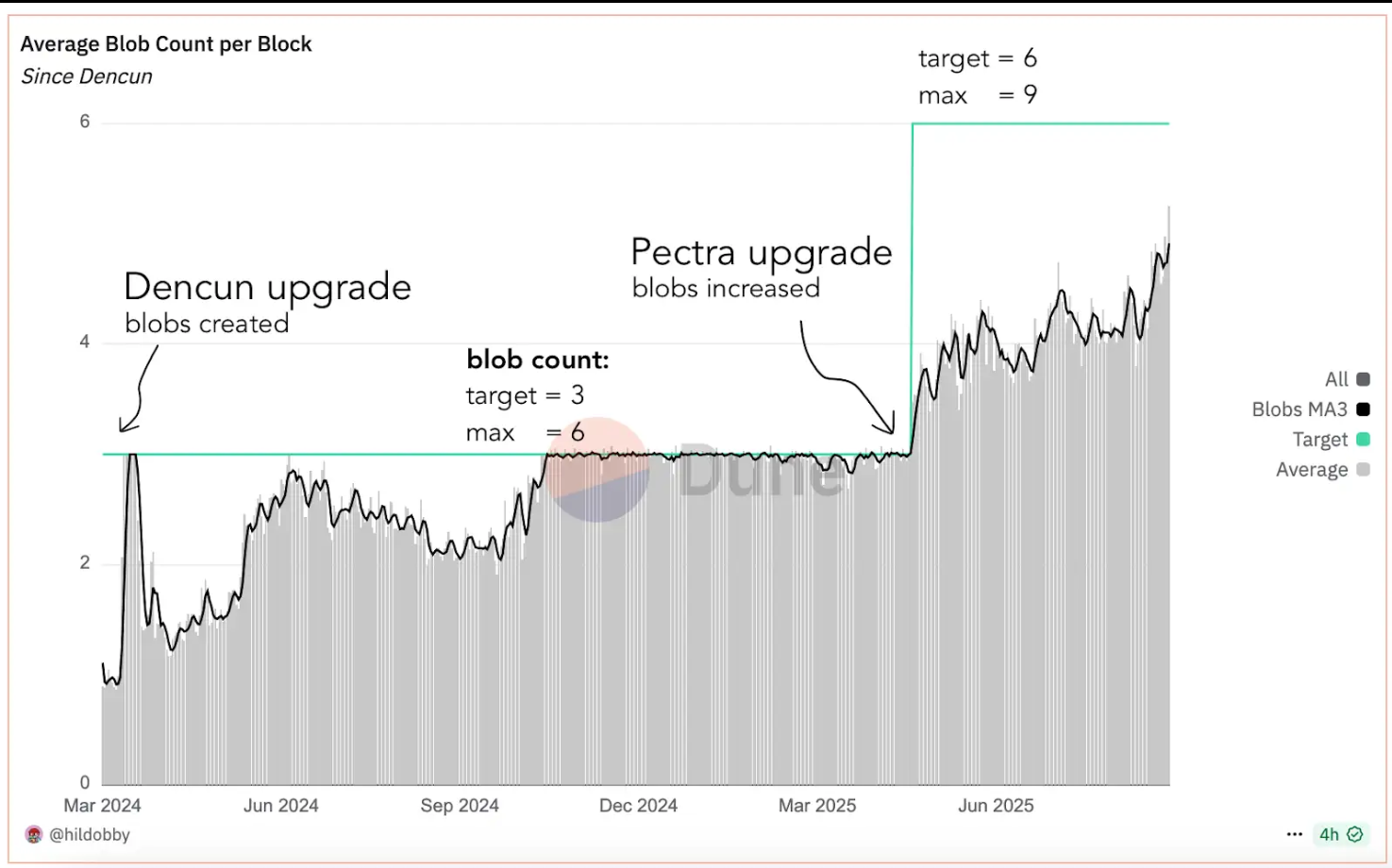
Average Blob Count per Block
Source: https://ethereum.org/roadmap/fusaka/#fusaka
This is when EIP-4844 introduced a feature called proto-danksharding, but let’s rewind quickly. Before the Dencun upgrade, Layer 2s were posting their data into a section of Ethereum blocks called “CALLDATA”, which:
- is used for smart contract inputs
- is expensive and
- is permanently stored on the Ethereum chain
None of which are useful for L2s. The core innovation that arrived with the Dencun upgrade was “blobs” – a dedicated spot in an Ethereum block for data that was cheap, flexible, and only stored temporarily on the Ethereum L1. At the time of the upgrade, a maximum of 6 blobs were permitted per block, which could be used by any L2 for data availability. Blobs were a massive improvement for L2s to use Ethereum for data availability, but issues around scaling persisted.
Fusaka: Main Event
The headline features for the Fusaka revolve around blobs and a brand new feature called Peer Data Availability Sampling, or PeerDAS, contained in EIP-7594. You can find a detailed overview of PeerDAS here, but let’s look at the basics.
The problem with blobs before Fusaka was that they took up a lot of disk space for nodes, even though they only needed to exist onchain for about 18 days. Data Availability Sampling (DAS) allows nodes to download a random fraction of the blob data, while still being capable of cryptographically verifying that all data is present in the network. In fact, the current version of PeerDAS allows nodes to only hold ~1/8 of the total blob data and be sure that the rest is available.
You can read up on how DAS works in a lot more detail in our recent Celestia article. For Ethereum, the introduction of PeerDAS means that nodes need only 1/8 the amount of disk space per blob, which also means that each Ethereum block can now hold more blobs without any sacrifice in security or performance.
In addition to PeerDAS, there are other blob related improvements as well. EIP-7883 and EIP-7823, for example, make slight increases to the cost of blobs to more accurately reflect their computational complexity. While PeerDAS will allow increased throughput of blobs, these EIPs will ensure that node operators are fairly compensated for handling them. Finally, Fusaka comes with two smaller upgrades scheduled in the near future, both of them “Blob Parameter Only” (BOP). BOP1 will occur on December 9th which will raise the maximum blobs per block to 15 with a target of 10, and BOP2 will occur on January 7th, raising the maximum and target blobs per block to 21 and 14 respectively.
Conclusion
As Ethereum node operators, we are massively encouraged by the speed at which the Ethereum core teams are moving ahead with their scaling roadmap. We are excited that L2s can expect more reliable blockspace for their data, and that active users of the L1 can expect cheaper transactions. Ethereum continues to be a hub of innovation in the crypto space, and we are thrilled to be contributing to its continued growth and operation.